Volunteering is not goodwill – it’s governance infrastructure
By Professor Michael E. Drew PhD Qld, FAICD, Volunteering Australia Chair
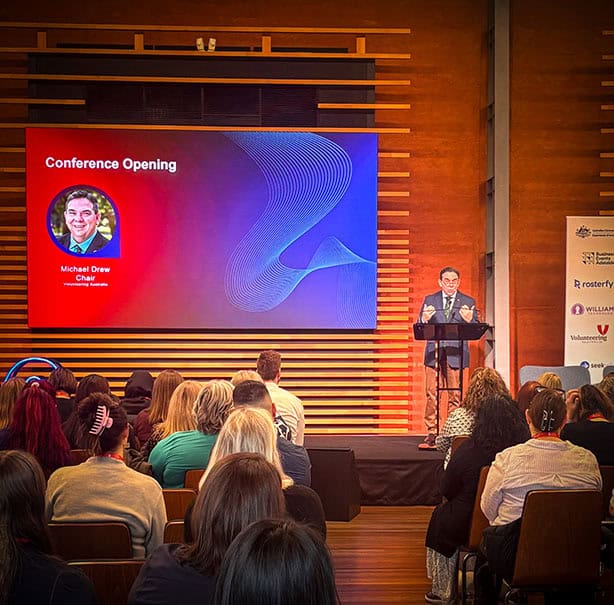
Recently, I attended a trustee meeting at one of Australia’s largest for‑purpose hospitals.
As I walked through the front doors of this nationally cherished place of healing and hope, I noticed the people who made it work.
Smiling volunteers at the reception guided visitors through the doors. Others moved quietly through the wards, delivering books and magazines. One walked beside an elderly patient to an appointment. Another supported a family in deep grief, while a colleague helped them share devastating news with relatives on a device.
By the time my meeting began, everyone I had encountered had been a volunteer.
Every one of them.
And it struck me that we still talk about volunteering as if it is a nice-to-have. Something that sits around the edges of the ‘real’ work.
Yet in a world‑class hospital, it was volunteers who first created care, connection, confidence and trust.
Not on the margins. At the heart.
That demands a harder question. If volunteering is so essential, why do so many organisations still treat it as optional?
We talk about reimagining volunteering. But first, we need to rethink how we value it.
Because the context is changing fast. Australia is ageing. Demand for care is rising. Communities are becoming more complex. Loneliness and social isolation are no longer issues at the margins. They are systemic risks.
The pressures are not coming. They are here. The real question is whether our institutions are ready.
For decades, the governance focus has been clear: Are we doing things right? Efficiency matters. Governance matters. Compliance matters.
But today, the more important question is: Are we doing the right things?
Are we investing in the social fabric that holds communities together? Are we strengthening the relationships that prevent people from falling through the cracks?
Volunteering cuts across the workforce, participation and community – yet it sits squarely at the centre of all three.
It is essential social infrastructure.
Just as roads move people and goods, volunteering builds trust, belonging, care and connection. And like all infrastructure, its value increases as systems become more complex.
Yet we rarely govern it that way.
Why don’t governments treat volunteering as national infrastructure? Why don’t boards recognise it as a strategic capability? Why don’t investors see it as a source of resilience?
And critically, why don’t more organisations treat it as a risk issue?
Few boards include volunteering on the enterprise risk register. Few risk leaders can clearly articulate the dependency. Fewer still have controls in place to manage a decline in volunteer participation.
But the risk is real.
If volunteers disappeared tomorrow, many services would not simply become less effective. Some would become impossible.
Too often, volunteering sits below strategy. Below risk. Below the conversations that shape the future of organisations.
That must change.
The future of volunteering is not about filling shifts. It is about redesigning institutions so that community participation is recognised as core business.
It means treating volunteers as strategic assets. Measuring social value with the same discipline as financial value. Embedding volunteering into governance frameworks, risk registers and operating models.
Most importantly, it means recognising that human connection is not a by‑product of the mission. In many cases, it is the mission.
The organisations that will thrive in the next decade will understand something simple: care cannot be delivered by clinicians alone. Community cannot be built by institutions alone.
Resilience cannot be purchased after a crisis. It must be built before it is needed.
That is the challenge. Not simply to reimagine volunteering, but to reframe it as core infrastructure.
To recognise volunteering not as a charitable add-on, but as a strategic national asset.
For the sake of volunteers – and the communities they support – we can, and we must, do better.