Risk and reward — a guide to the 2026 Federal Budget

Budget overview
Governance Institute welcomes the focus on productivity and improvements to the regulatory environment with several key announcements to simplify and streamline costly regulations.
The Treasurer Jim Chalmers says this is the “most important and ambitious Budget in decades”. The conflict, he stresses, in the Middle East is “pushing up prices, pushing down growth and punishing Australians”. It has been a tough year for the Australian economy. Even before the war in the Middle East, inflation was driving up interest rates and growth was stalling. The budget’s ambition is clear: to restore equity in the housing market, strengthen productivity, reform the tax system to restore standards of living and boost economic growth. The Treasurer expects bold tax changes on property investments to take some of the heat out of one of the world’s least affordable housing markets. The Labor government is using its strong parliamentary majority to tackle major structural issues as the cost-of-living crisis becomes the dominant political issue. That reform push is now translating into targeted measures to lift productivity and ease the regulatory burden.
Key announcements include $136.1 million allocated as part of the business registry uplift project as well as $780 million per year by progressing 14 legislative reforms in the financial sector. The budget will cut costs for businesses of complying with government regulations by $10 billion a year including simplification of climate-related financial disclosures and financial regulations reporting.
Economic and fiscal overview
Middle East conflict volatility to impact economic growth
The government highlights that the conflict in the Middle East will result in higher global inflation and lower growth, with the scale of the impact dependent on how long the war lasts and the severity of its consequences. The conflict, it notes has compounded cost pressures for households and businesses and is straining some supply chains.
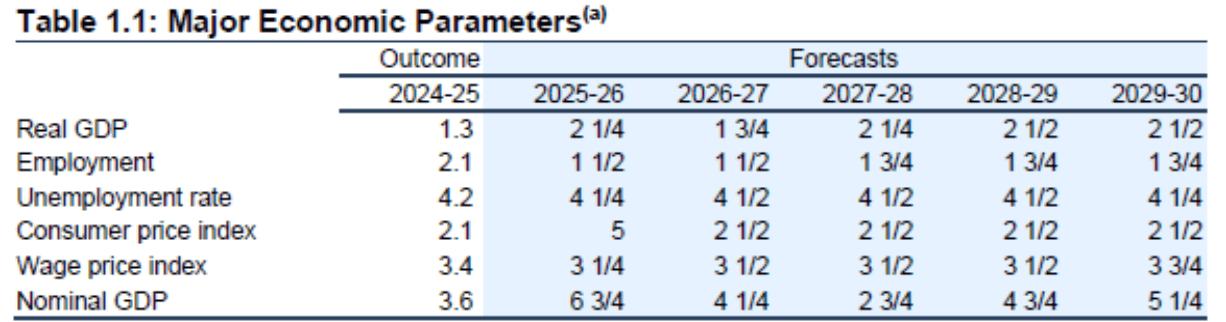
Growth in the Australian economy is forecast to slow from 2.25 per cent in 2025–26 to 1.75 per cent in 2026–27. While the economic outlook remains highly uncertain, the Australian economy is expected to grow by 2.25 per cent in 2027–28.
A protracted Middle East conflict has not been ruled out
The government prepared forecasts for a more severe Middle East conflict that continues to the middle of 2027 rather than a baseline scenario of the middle of 2026. This assumes oil prices peak at US$200 per barrel during the September quarter 2026 if the conflict escalates.
Under this scenario, inflation peaks at around 7.25 per cent through the year to the December quarter 2026. One quarter of negative real GDP growth in the September quarter 2026 and persistent weakness in the economy. The level of real GDP is 0.5 per cent lower across both 2026-27 and 2027-28 and remains lower by 0.25 per cent across 2028-29, compared to forecasts.
Inflation expected to grow sharply then decline
Headline inflation rose to 4.6 per cent in the 12 months to March 2026, driven by a 32.8 per cent rise in automotive fuel prices in the month. The impact of higher fuel prices is expected to broaden in the coming months, as prices flow through to other goods and services.
Headline inflation is forecast to be 5 per cent through the year to the June quarter 2026 and is forecast to decline to 2.5 per cent through the year to the June quarter 2027, supported by an assumed decline in global oil prices from the middle of 2026, a resolution of temporary pressures, and a moderation in services inflation.
Labour market and wages to remain resilient
The labour market is expected to remain resilient despite the fallout from the Middle East conflict. Employment is likely to grow, and the participation rate is expected to remain close to its recent record high. The unemployment rate is forecast to remain low by historical standards, gradually increasing from 4.25 per cent in the June quarter 2026 to 4.5 per cent in the 2027 June quarter, through to the June quarter in 2028. The unemployment rate is expected to remain well below its average in the decade before the pandemic.
The Wage Price Index is forecast to grow by 3.25 per cent through the year to the June quarter 2026, before increasing to 3.5 per cent through the year to the June quarter 2027 and the June quarter 2028. The Wage Price Index has grown at an annual rate above 3 per cent since the September quarter 2022. This is the longest period in more than a decade and a half that annual growth has been above 3 per cent, and this is expected to continue over the forecast period
Productivity forecast remains below historical averages
The long-term underlying productivity assumption is 1.2 per cent per year. Government forecasts note that labour market productivity has improved to 1.0 per cent. The transition to the long-term rate of underlying productivity growth is assumed to occur over a period of around five years.
Business investment forecasts
Business investment growth picked up substantially in the second half of 2025. Momentum is expected to continue, with business investment forecast to grow by 4 per cent in 2025–26, 2½ per cent in 2026‑27 and 2 per cent in 2027–28. Recent capital expenditure expectations have been revised upwards, but these could be reversed as businesses factor in the impact of higher input prices because of the conflict in the Middle East. Higher borrowing costs could weigh on profitability.
Fiscal strategy and outlook
Gross debt is estimated to tip over $1 trillion dollars for financial year 2026-27.
A deficit of 1.0 per cent of GDP ($28.3 billion) is expected in 2025–26, an improvement of 0.3 percentage points ($8.5 billion) since MYEFO. A deficit of 1.0 per cent of GDP ($31.5 billion) is forecast for 2026–27, an improvement of 0.1 percentage points ($2.8 billion) since MYEFO. Over the forward estimates period there has been a $44.9 billion improvement in the underlying cash balance since MYEFO. This is largely due to cost-cutting measures including reforms the NDIS, further reducing public service spending and returning uncommitted funding across discretionary programs.
Since MYEFO, expected payments–to–GDP have reduced by 0.3 percentage points in 2025–26, 0.1 percentage points in 2026–27 and 0.7 percentage points at the end of the forward estimates. Receipts–to–GDP are broadly unchanged in 2025–26 and 2026–27.
Since MYEFO, the government has committed $14.0 billion in unavoidable spending to strengthen essential services that Australians rely on and address urgent and unforeseen issues.
Major Policy announcements
Digital economy
The government has announced the accelerated development and commercialisation of AI by Australian researchers and businesses. $70m will be made available through upcoming rounds of the Cooperative Research Centres (CRC) and CRC-P program starting in 2026 and 2027 for an ‘AI Accelerator’. The government continues to roll out policy announcements set out in the National AI Plan.
The government will spend $160.4 million over four years from 2025–26 for the Services Australia Cyber Security Uplift program.
The government will provide $89.3 million over four years from 2026–27 to sustain and enhance cyber security initiatives.
$22.2 million over four years from 2026–27 (and $5.7 million per year ongoing) has been set aside for the Office of the Australian Information Commissioner to continue to provide privacy oversight under the Digital ID legislation and Identity Verification Service programs
The government will provide $654.3 million over four years from 2026–27 (and $166.7 million per year ongoing) to meet its legislative commitments under the Digital ID Act 2024 and maintain the security and reliability of the Australian government’s Digital ID System.
Productivity
The Treasurer Jim Chalmers will try to reinvigorate Australia’s lacklustre productivity growth by cutting regulatory costs by $10 billion a year for business, including for project approvals, tax system compliance, international trade and building regulations. The Reserve Bank has warned that without improvements in the economy’s ability to supply more goods and services, inflation will remain stubborn and workers’ wages will remain suppressed.
Regulation
The government will reduce regulatory burden in the financial sector by $780 million per year by progressing 14 legislative reforms. The reforms include increasing the monetary thresholds for large proprietary companies, improving the efficiency of climate-related financial disclosures, further modernising business communications by making electronic recordkeeping and communication with ASIC easier and extending previous technology neutrality reforms to the Australian Small Business and Family Enterprise Ombudsman.
The government will be progressing reforms to deliver a ‘tell us once’ approach that reduces the amount of time Australians spend providing the same information across different areas of government
Regulatory deep dives will be progressed in priority areas – the financial sector, tax, young firms and business dynamism, housing, higher education regulation, the national construction code, data centre approvals and ‘white tape’ – to strengthen regulatory systems while reducing burden.
$136.1 million over two years from 2026–27 has been allocated to complete the second tranche of stabilisation and uplift of Australia’s business registers, including synchronising director information with the Australian Charities and Not‑for-profits Commission Charity Register, linking Director IDs to the Companies Register, uplifting Australian Business Number (ABN) authentication and completing the transition of ABN and superannuation lookup functions to the Australian Taxation Office.
$62.0 million over two years from 2026–27 to extend the operation and participation in the Consumer Data Right to continue supporting Australian consumers and businesses and to explore the potential to enable taxpayers to share certain ATO‑held data through the Consumer Data Right.
The government will introduce legislation to modernise, simplify and improve regulation in the financial sector. The reforms will:
- reduce unnecessary reporting and disclosure requirements
- implement reforms to regulatory requirements for small and medium-sized banks
- modernise and simplify financial system frameworks.
$4.8 million over four years from 2026–27 to finalise funding arrangements for External Reporting Australia, which will replace the Australian Accounting Standards Board, the Auditing and Assurance Standards Board and the Financial Reporting Council, including additional resourcing to support climate sustainability reporting.
The government will remove the ministerial declaration requirement from the community charity DGR (Deductible Gift Recipient) process, reducing red tape for eligible community charities by removing a step in the endorsement process.
Business tax incentives
The government is making the tax system simpler so businesses can spend more time running their business and less time on tax.
From 1 July 2026, the government will permanently extend the $20,000 instant asset write‑off for small businesses with turnover up to $10 million. Assets valued at $20,000 or more can continue to be placed into the small business simplified depreciation pool. The provisions that prevent small businesses from re‑entering the simplified depreciation regime for 5 years after opting out will continue to be suspended until 30 June 2027.
Housing policy
From July 1, 2027, the government will scrap the 50% capital gains tax discount on assets held for more than a year and return to the pre-1999 policy of taxing inflation-indexed gains, with a 30% minimum tax on net capital gains.
These changes will apply to all CGT assets, held by individuals, trusts and partnerships. For existing investments, transitional arrangements will ensure the changes only apply to gains arising on or after July 1, 2027. The 50% CGT discount will continue to apply to gains arising before July 1, 2027.
From the evening of May 12, new property purchases will not be eligible to use negative gearing unless it is a newly built home. From July 2027, a capital gains tax – a discount that halves the tax owed on any profit made from selling shares, investment properties or other assets held for more than a year – will end.
The government will extend the temporary ban on foreign purchases of established residential dwellings by two years and three months until 30 June 2029. The ban was originally implemented for two years from 1 April 2025.
The government will provide $2.1 billion over five years from 2025–26 to support increased housing supply and research. Funding includes:
- $2.0 billion over four years from 2026–27 for the Housing Support Program
- $56.4 million over four years from 2025–26 for the Treasury to support the oversight and delivery of key programs under the government’s Homes for Australia plan and for a public campaign to inform taxpayers of the changes to the tax system
- $2.1 million in 2026–27 to extend Commonwealth funding to support the Australian Housing and Urban Research Institute
National fuel security package
More than $10bn will be spent improving Australia’s fuel security as the government tries to shield Australia from the long-term consequences of the war in Iran. The package will include $3.7 billion to establish a government-owned fuel security reserve that will hold 1 billion litres of emergency diesel and aviation fuel.
Defence spending
In the face of “intensifying” global risks, the government plans to increase defence spending to 3 per cent of gross domestic product (GDP) by 2033, when measured using NATO’s methodology. An additional $53 billion will be spent on defence over the next decade, including a $14 billion lift in spending in the next four years. Much of the new spending is tied to major projects like the AUKUS nuclear-powered submarine program, but there is also spending on long-range strike missiles, drones and counter-drone technology.
NDIS cuts
The budget aims to reduce the National Disability Insurance Scheme, which is now costing $50 billion a year – four times more expensive than expected. To preserve the scheme’s “social licence”, the government wants to reduce its annual growth rate from about 10 per cent down to 5 or 6 per cent long-term. Cost-saving measures include pushing more than 160,000 participants off the NDIS and onto state-run support programs by 2030.
$1k tax deduction for workers
The signature cost-of-living piece in this budget is an ongoing $250 tax offset for more than 13 million working Australians, starting in 2027–28. Treasurer Jim Chalmers is attributing the delay to avoid fuelling inflation in the near term. From the 2026–27 financial year, Australians who earn income from work will be able to claim an instant deduction to cover off up to $1,000 worth of work expenses, meaning they won’t need to claim individual items.